
Tuesday, May 31, 2011

Stop Procrastinating, Start Achieving

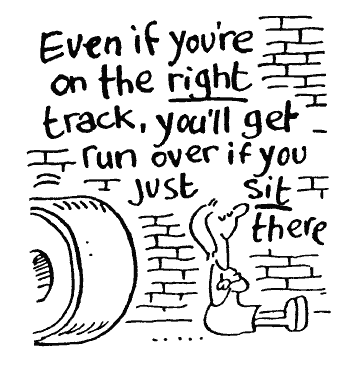
According to a recent poll 20% of the population are chronic procrastinators, does the following sound familiar?
“Making a decision for no valid reason to delay or not complete a task or goal you’ve committed too, and instead doing something of lesser importance, despite there being negative consequences to not following through on the original task or goal”.
If so you are probably a procrastinator, but don't lose heart here we will explore the reasons behind procrastination and most importantly ways to stop procrastination in its tracks.
Negative Self Talk
You may procrastinate due to your negative self talk. In my experience working with clients’ negative self talk is the number one thing that holds them back. Do you berate yourselves about things that you should or should not have done? Often we paralyse ourselves before we get off the starting blocks. If you are consumed with self doubt and criticism begin to become aware of the tapes you play over and over in your mind
Overcomplicating
Over 700 years ago, William from a village called Ockham surmised that “Entities must not be multiplied beyond necessity.” This has become known as “Ockham’s Razor”. This simple idea has become a universal tool for proving things in science, philosophy and psychology. The idea is that the process with the least amount of steps tends to be the one that will have the best outcome or as Elbert Einstein put it: “Everything should be made as simple as possible – but no simpler”. Overcomplicating is just another form of procrastination. We often do this when we are trying to avoid taking action, be it forever planning a project, researching our competition, developing a new service or product. This is often due to fear or lack of belief in our abilities which can lead us to procrastinate far longer than is necessary. In order to be successful you have to bite the bullet and deal with things in a methodical manner, but keep propelling yourself forward.
Complicating facets of our lives also helps shift responsibility away from us, as we try to blame other factors for out lack of action. If this rings true for you, try to become aware of when you are making things more difficult than they ought to be and gently question why you may be doing this. You may be surprised by the answers. Sometimes it can be because we don’t want to actually do the thing in the first place. If this is the case, look at alternatives or if it must be done, try to do it thoroughly and quickly, without overanalysing. As the saying goes “analysis is paralysis”. Don’t stay stuck, take some tentative steps towards your goal and you will reap the rewards. Not only will you feel a sense of accomplishment, but you will also have proof that you can get through things e
Intention
As Albert Schweitzer said “Success is not the key to happiness. Happiness is the key to success. If you love what you are doing, you will be successful.” If not you are more likely to procrastinate.
5 Powerful Ways to Stop Procrastination in its tracks:
1. Identify when you are substituting a lesser task in order to avoid the more important task you have committed too. This is a classic way that many of us procrastinate. If you struggle with this, I suggest you read Eat That Frog by Brian Tracy, who states that you start your day by doing the tasks you like least first, so you can then enjoy the rest of your day more.
2. Become aware of the reason behind your procrastination, is it because of fear? boredom? lack of energy? lack of interest? Sometimes it can be because we are simply in the wrong type of job. You need to enjoy your work and if you don't you need to start thinking about how you can or find a job that suits your skills better.
3. If you find yourself reading e-mails several times without starting work on them or deciding what you’re going to do with them, make a commitment to read them once and either respond to them or delete them. I have a client I coach that deletes his entire inbox monthly. He says that if it is that important they will email again or call and it frees him up for more pressing tasks. You may not want to do something that drastic, but do become aware of your inbox and allocate a set amount of time daily.
4. Spending too much time on social network sites at work or at home? Allow yourself a set amount of time daily or twice a day for fifteen minutes and then log off! Easier said than done, but I promise you that you will save so much time.
5. Set some goals. We can easily let time runaway from us and as the hours turn into days, weeks into months and then years we need to question what we want out of life and if indeed we are getting what we want. If you are not satisfied with your life, you are the only one that can change it. Make some clear goals that excite you. Then set a time when you want to achieve them by and work consistently towards those goals.
All successful people work towards goals, so have you written yours yet?
Monday, April 25, 2011
What side of your personality do you show?
This is a great article from Deepak Chopra about the shadow side of our personality http://www.chopra.com/agnilight/jul10
The Shadow
The essential nature of the universe is the coexistence of opposites. We cannot be a hero if we don’t also contain a coward inside of us. We cannot be generous if we don’t also possess an inner miser. We cannot be virtuous if we don’t have the capacity for evil. Yet most of us have been conditioned to deny our shadow – those hidden places where we repress our guilt, confusion, and pain.
When we wall off the painful parts of our past, the shame doesn’t just go away, it festers and darkens into our shadow self. It seeks recognition and reintegration by erupting as self-sabotaging thoughts and behavior and even exaggerated dark dreams. We also may end up projecting these denied qualities onto other people in our lives. Have you ever known people who continually attract the “wrong people” into their lives? In reality, they are not attracting that darkness, but they are not willing to acknowledge it in their own lives. This is unfortunate because the shadow also comes with a gift: an opportunity to expand our personal awareness and experience our wholeness.
If we want to find our true self, we must dive into the shadow, recover the parts of ourselves that we have split off, and embrace the paradox of the coexistence of opposites. With loving attention, we can heal our past and harness the power of our fully illumined self. How do we do this? I have found the following steps useful:
Step 1: Stop Projecting.
Projection is an unconscious defense in which we ignore our own weaknesses and project them onto others. For example, we may feel incensed about a celebrity’s indulgent behavior because our shadow contains a hidden desire to engage in excess. Projection can take many forms, including jealousy, paranoia, arrogance, superiority, prejudice, and idealizing others. The instant you catch yourself projecting a hidden feeling, you need to contact that feeling and allow yourself to feel it. This isn’t always easy, so be patient with yourself.
Step 2: Detach and Let Go.
You have already begun this process by acknowledging your feelings. Now you need to release the negativity. The most direct way is to set the intention to be detached, centered, patient, and self-aware.
Step 3: Give up Self-Judgment.
While emotions are commonly categorized as “positive” or “negative,” in reality every emotion is valid in some way or another. But when you add self-judgment, any emotion can be damaging. Instead, begin to cultivate sympathy for whatever emotion arises in your experience. Instead of heaping judgment on yourself for what you are feeling, see if you can offer yourself compassion. Doing so will take the judgment out of your emotions and give yourself permission to be who you are.
Step 4: Rebuild Your Emotional Body.
Like our physical body, our emotional body can become diseased, tired, and flabby when it’s exposed to toxins and unhealthy influences. To keep your emotional body energetic, flexible, and a source of pleasure, it needs proper nourishment. Spend some time tuning into to your emotional body and ask it what it needs. If you have been holding on to emotional pain for some time, you may want to consider attending the Free to Love workshop at the Chopra Center, where you will be guided in a deep process for letting go of accumulated guilt, pain, anger, and repressed feelings that continue to create distress in your life. Learn more about Free to Love here.
As you practice these steps, be aware that even most confident, well-adjusted people will reflexively diminish the significance of their shadow side. This is instinctive self-preservation, because it’s hard to accept that we can have this dark matter in us when we have worked our whole life to build a personality around the ideals of love, compassion, and generosity. Nevertheless, when you can look at this material and accept it as part of you, yet knowing that it is not your true essence, then you begin a deep healing of self-forgiveness and re-integration.
Those painful areas that have been holding anger, resentment, and self-judgment no longer have to be shut away in the basement and can now be healed and brought into harmony with your soul. You will also notice that as the contents of the shadow become fully transparent to the light, you will free up all that energy in you that was locked up in your civil war, and it will now be available for more creative expressions and for a fuller appreciation of life around you.
Love,
Deepak
© Copyright 2010 The Chopra Center at La Costa Resort and Spa
The Shadow
The essential nature of the universe is the coexistence of opposites. We cannot be a hero if we don’t also contain a coward inside of us. We cannot be generous if we don’t also possess an inner miser. We cannot be virtuous if we don’t have the capacity for evil. Yet most of us have been conditioned to deny our shadow – those hidden places where we repress our guilt, confusion, and pain.
When we wall off the painful parts of our past, the shame doesn’t just go away, it festers and darkens into our shadow self. It seeks recognition and reintegration by erupting as self-sabotaging thoughts and behavior and even exaggerated dark dreams. We also may end up projecting these denied qualities onto other people in our lives. Have you ever known people who continually attract the “wrong people” into their lives? In reality, they are not attracting that darkness, but they are not willing to acknowledge it in their own lives. This is unfortunate because the shadow also comes with a gift: an opportunity to expand our personal awareness and experience our wholeness.
If we want to find our true self, we must dive into the shadow, recover the parts of ourselves that we have split off, and embrace the paradox of the coexistence of opposites. With loving attention, we can heal our past and harness the power of our fully illumined self. How do we do this? I have found the following steps useful:
Step 1: Stop Projecting.
Projection is an unconscious defense in which we ignore our own weaknesses and project them onto others. For example, we may feel incensed about a celebrity’s indulgent behavior because our shadow contains a hidden desire to engage in excess. Projection can take many forms, including jealousy, paranoia, arrogance, superiority, prejudice, and idealizing others. The instant you catch yourself projecting a hidden feeling, you need to contact that feeling and allow yourself to feel it. This isn’t always easy, so be patient with yourself.
Step 2: Detach and Let Go.
You have already begun this process by acknowledging your feelings. Now you need to release the negativity. The most direct way is to set the intention to be detached, centered, patient, and self-aware.
Step 3: Give up Self-Judgment.
While emotions are commonly categorized as “positive” or “negative,” in reality every emotion is valid in some way or another. But when you add self-judgment, any emotion can be damaging. Instead, begin to cultivate sympathy for whatever emotion arises in your experience. Instead of heaping judgment on yourself for what you are feeling, see if you can offer yourself compassion. Doing so will take the judgment out of your emotions and give yourself permission to be who you are.
Step 4: Rebuild Your Emotional Body.
Like our physical body, our emotional body can become diseased, tired, and flabby when it’s exposed to toxins and unhealthy influences. To keep your emotional body energetic, flexible, and a source of pleasure, it needs proper nourishment. Spend some time tuning into to your emotional body and ask it what it needs. If you have been holding on to emotional pain for some time, you may want to consider attending the Free to Love workshop at the Chopra Center, where you will be guided in a deep process for letting go of accumulated guilt, pain, anger, and repressed feelings that continue to create distress in your life. Learn more about Free to Love here.
As you practice these steps, be aware that even most confident, well-adjusted people will reflexively diminish the significance of their shadow side. This is instinctive self-preservation, because it’s hard to accept that we can have this dark matter in us when we have worked our whole life to build a personality around the ideals of love, compassion, and generosity. Nevertheless, when you can look at this material and accept it as part of you, yet knowing that it is not your true essence, then you begin a deep healing of self-forgiveness and re-integration.
Those painful areas that have been holding anger, resentment, and self-judgment no longer have to be shut away in the basement and can now be healed and brought into harmony with your soul. You will also notice that as the contents of the shadow become fully transparent to the light, you will free up all that energy in you that was locked up in your civil war, and it will now be available for more creative expressions and for a fuller appreciation of life around you.
Love,
Deepak
© Copyright 2010 The Chopra Center at La Costa Resort and Spa
Friday, April 8, 2011
Feeling Blue?

We often say that we are down or depressed, but how many of us actually know the clinical symptoms of depression? The most common psychological disorder reported by GP's is depression. In order to be diagnosed with depression an individual must report most of the following symptoms over a two week period:
- · feeling sad most of the time
- · lost interest in most of your usual activities
- · lost or gained weight
- · felt excessively guilty
- · sleep disturbance
- · felt worthless
- · had poor concentration
- · were very indecisive
Looking at the list above, I think many people may have experienced these symptoms at one time or another, including myself. There is no one single cause of depression and consequently there is no one quick fix either. If you think you may be depressed please seek help, early intervention ensures that you will get the support you need. Be honest about how you are feeling, as keeping things to yourself or pretending everything is fine will only aggravate the illness further.. You deserve to live a life of calm, peace and purpose. As a coaching psychologist I have seen many clients struggle with depression and it skews their judgement, robs them of their creativity, plants seeds of doubt that manifest and fester.
When someone is experiencing depression it is like they are shrouded in a veil which prevents them from seeing things logically or clearly. They may make poor decisions or indeed feel immobilised to make any decisions. Depression can be misunderstood and people can feel that the individual suffering from depression is doing it for attention, or trying to be difficult, they are not. They are genuinely struggling with their emotions and no doubt finding it increasingly difficult to do their job effectively whether in work or at home.
Take action instead of denying how you are feeling if you are depressed, rest assured that many people have experienced depression, including well known celebrities like Jim Carey, Larry King, Marion Keyes, Jessica Rowe and Britney Spears. It is not a life long illness and with support and taking positive steps depression can be managed successfully.
The following link is for a quick depression self test. The site also offers a wealth of information, factsheets and support.
Saturday, March 26, 2011
Stop Procrastinating Now
…making a decision for no valid reason to delay or not complete a task or goal
you’ve committed too, and instead doing something of lesser importance,
despite there being negative consequences to not following through on the original
task or goal.
If so you are probably a procrastinator.. but don't lose heart here are
5 Powerful Ways to Stop Procrastination in it's tracks:
- Identify when you are substituting a lesser task in order to avoid the more important task you have committed too. This is a classic way that many of us procrastinate. If you struggle with this, I suggest you read Eat That Frog by Brian Tracy, who suggests that you start your day by doing the tasks you like least first, so you can then enjoy the rest of your day more.
- Become aware of the reason behind your procrastination, is it because of fear? boredom? lack of energy? lack of interest? Sometimes it can be because we are simply in the wrong type of job. You need to enjoy your work and if you don't you need to start thinking about how you can or find a job that suits your skills better.
- If you find yourself reading e-mails several times without starting work on them or deciding what you’re going to do with them, make a commitment to read them once and either respond to them or delete them. I have a client I coach that deletes his entire inbox monthly. He says that if it is that important they will email again or call and it frees him up for more pressing tasks. You may not want to do something that drastic, but do become aware of your inbox and allocate a set amount of time daily.
- Spending too much time on social network sites at work or at home? Allow yourself a set amount of time daily or twice a day for fifteen minutes and then log off! Easier said than done, but I promise you that you will save so much time.
- Set some goals. We can easily let time runaway from us and as the hours turn into days, weeks into months and then years we need to question what we want out of life and if indeed we are getting what we want. If you are not satisfied with your life, you are the only one that can change it. Make some clear goals that excite you. Then set a time when you want to achieve them by and work consistently towards those goals. All successful people work towards goals, so have you written yours yet?
Friday, March 18, 2011
Three techniques to reduce STRESS instantly
Feeling Stressed? Here are 3 tenhniques to reduce stress instantly:
1. BREATHE
The benefits of effective abdominal breathing have been shown to be benefical to both our physical and psychological wellbeing. Take three full breathes through your nose and out through your mouth whilst keeping your eyes closed.
2. MOVE
Although you may not feel like it, exercising when stressed offers an instant way of releasing pent up stress, whilst flooding your body with happy chemicals known as endorphins. It also helps you become more rational and focused. Just get up and walk around the block and you will return with a clearer head.
3. CONFRONT
Many of us complain to our co-workers about our spouse or other family members and then we get home and complain to our spouse about our co-workers or boss and we wonder why nothing has changed and why we are still stressed. Don't let things fester and get out of control, talk to the person you need to calmly in order to be heard and for things to change.

1. BREATHE
The benefits of effective abdominal breathing have been shown to be benefical to both our physical and psychological wellbeing. Take three full breathes through your nose and out through your mouth whilst keeping your eyes closed.
2. MOVE
Although you may not feel like it, exercising when stressed offers an instant way of releasing pent up stress, whilst flooding your body with happy chemicals known as endorphins. It also helps you become more rational and focused. Just get up and walk around the block and you will return with a clearer head.
3. CONFRONT
Many of us complain to our co-workers about our spouse or other family members and then we get home and complain to our spouse about our co-workers or boss and we wonder why nothing has changed and why we are still stressed. Don't let things fester and get out of control, talk to the person you need to calmly in order to be heard and for things to change.
Monday, January 31, 2011
Are you a Pessimist or an Optimist?
"...everything can be taken from us but one thing: the last of human freedoms — to choose one's attitude in any given set of circumstances — to choose one's own way." — Viktor Frankl, neurologist, psychiatrist, author of the classic, Man's Search for Meaning: Experiences in the Concentration Camp, and 25 other books on existentialism, psychology, and meaning
An optimist expects the best possible outcome and dwells on the most hopeful aspects of a situation. He or she believes that this is the best of all possible worlds, the universe is improving, and good will ultimately triumph over evil. An optimist believes no one ever ruined their eyesight by looking at the bright side of life. Research on Emotional Intelligence, Attribution Theory (see Martin Seligman's outstanding book Learned Optimism), and related fields show that optimists not only go farther in life, they also have a much better time on the trip. Optimists are generally healthier, happier, and leaders in their fields.
Pessimists stress the negative and take the gloomiest possible view. He believes that this is the worst of all possible worlds, things naturally tend toward evil, and evil ultimately overshadows good. Pessimists feel that gravity is a myth; the world sucks. She thinks everybody is as nasty as her and hates them for it. When a pessimist feels good, he feels bad because he's afraid of feeling worse when he feels better. Highly devoted pessimists take joy from proving there is no real or lasting joy. If life were a bed of roses, many pessimists wouldn't be happy until they developed an allergy. Pessimists not only expect the worst, they make the most of it when it happens.
Which view is reality? Since we see the world as we are, either view becomes our reality. We choose our outlook. We choose to be an optimist or a pessimist. Here's how former American Secretary of Education William Bennett puts it, "It is a matter of choice. That is perhaps the greatest insight that the ancient Roman Stoics championed for humanity. There are no menial jobs, only menial attitudes. And our attitudes are up to us." We may have been given a tendency toward optimism or pessimism at birth, from our upbringing, or through the environment we're now in. However we can decide what we want to become from this day forward.
An optimist expects the best possible outcome and dwells on the most hopeful aspects of a situation. He or she believes that this is the best of all possible worlds, the universe is improving, and good will ultimately triumph over evil. An optimist believes no one ever ruined their eyesight by looking at the bright side of life. Research on Emotional Intelligence, Attribution Theory (see Martin Seligman's outstanding book Learned Optimism), and related fields show that optimists not only go farther in life, they also have a much better time on the trip. Optimists are generally healthier, happier, and leaders in their fields.
Pessimists stress the negative and take the gloomiest possible view. He believes that this is the worst of all possible worlds, things naturally tend toward evil, and evil ultimately overshadows good. Pessimists feel that gravity is a myth; the world sucks. She thinks everybody is as nasty as her and hates them for it. When a pessimist feels good, he feels bad because he's afraid of feeling worse when he feels better. Highly devoted pessimists take joy from proving there is no real or lasting joy. If life were a bed of roses, many pessimists wouldn't be happy until they developed an allergy. Pessimists not only expect the worst, they make the most of it when it happens.
Which view is reality? Since we see the world as we are, either view becomes our reality. We choose our outlook. We choose to be an optimist or a pessimist. Here's how former American Secretary of Education William Bennett puts it, "It is a matter of choice. That is perhaps the greatest insight that the ancient Roman Stoics championed for humanity. There are no menial jobs, only menial attitudes. And our attitudes are up to us." We may have been given a tendency toward optimism or pessimism at birth, from our upbringing, or through the environment we're now in. However we can decide what we want to become from this day forward.
Subscribe to:
Posts (Atom)


 Posts
Posts


